We compare real products, not imaginary winners. Every Amazon link uses affiliate tag brazenprodu01-20, which helps keep the site running at no extra cost to you.
A professional detail at a shop runs $150–$300. At home, with the right supplies and process, you can get results that are just as good — and do it on your schedule. The key word is process. Most people who try home detailing get mediocre results because they skip steps, use the wrong order, or use the wrong products for their paint type.
This guide covers the full sequence: exterior pre-rinse, two-bucket wash, clay bar treatment, paint protection, wheel and tire care, glass cleaning, and interior deep clean. Whether you're starting with a beginner car wash kit or building out a more complete setup, the process is the same.
What You'll Need Before You Start
Don't start with a product you don't have. Gather everything first so you're not stopping mid-detail to go find a towel. Here's the full supply list:
| Category | What You Need | Priority |
|---|---|---|
| Wash | Car wash soap, two buckets, wash mitt, grit guards | Essential |
| Rinse | Garden hose with spray nozzle or pressure washer | Essential |
| Dry | Large microfiber waffle-weave drying towel or air blower | Essential |
| Clay bar | Clay bar kit with detailing spray lubricant | Every 3–6 months |
| Protection | Car wax, paint sealant, or ceramic spray | Essential |
| Wheels/Tires | Wheel cleaner, stiff lug nut brush, tire dressing | Essential |
| Glass | Auto glass cleaner, microfiber glass cloth | Essential |
| Interior | All-purpose interior cleaner, vacuum, soft brush, detailing spray | Essential |
| Seats | Leather conditioner (leather seats) or fabric protector (cloth) | Optional upgrade |
✅ Pro Tip: Detail in the shade, never in direct sun
Soap, clay bar lube, wax, and sealant all dry faster in direct sunlight — which means streaks, water spots, and residue that's hard to buff out. Park in a garage or a shaded area. If you have to work outdoors, do it in the morning or evening when temperatures are lower.
Step-by-Step: Full Exterior Detail
1Pre-rinse and wheels first
Start with a thorough rinse of the entire car using a garden hose or pressure washer. The goal is to remove loose dirt and debris before anything touches the paint. Then do the wheels and tires before the paint — wheels kick up the nastiest brake dust and contamination. If you do paint first, you'll splatter it while cleaning wheels.
- Spray wheel cleaner into the wheel barrel, lug nut holes, and face
- Agitate with a dedicated wheel brush (never use paint-side brushes here)
- Rinse thoroughly and move to the next wheel
- Apply tire dressing to the tire sidewall — avoid getting it on the tread or brake components
2Two-bucket wash method
The two-bucket method is the single most important technique for avoiding swirl marks. Bucket 1 has your soapy wash solution. Bucket 2 has plain rinse water (with a grit guard in the bottom). After each panel, rinse your wash mitt in Bucket 2 before reloading it in Bucket 1. This stops you from dragging grit back across the paint.
- Wash from top to bottom — roof first, doors and quarter panels after, rocker panels last
- Use straight-line motions, not circles — circular scrubbing creates swirl patterns
- Reload the mitt with fresh soap water after every 1–2 panels
- Do door jambs and the underside of the trunk/hood before the final rinse
3Final rinse and dry
Do a full rinse from top to bottom. For the drying stage, use a large waffle-weave microfiber drying towel — not a bath towel, not chamois leather (they drag and scratch). Blot and drag gently rather than pressing hard. For water in crevices and trim gaps, use a compressed air can or leaf blower on low to blow out the water before it spots.
4Clay bar treatment (when needed)
Run the zip-lock bag test: slip your hand inside a plastic bag and glide it over the clean, dry paint. If you feel roughness or grit, your paint has above-surface contaminants (industrial fallout, tree sap particles, overspray) that washing can't remove. That's when you need a clay bar.
- Work one small section at a time (2x2 foot areas)
- Mist the surface generously with clay bar lubricant spray — never clay dry paint
- Glide the clay bar back and forth with light pressure — you'll feel and hear it pick up contaminants
- Fold the clay to a clean surface when it gets dirty, and add more lubricant as needed
- After each section, wipe with a clean microfiber to check the surface is smooth
Drop your clay bar? Throw it out. Any clay that hits the ground should never touch your paint again — the contamination risk isn't worth it.
5Apply paint protection (wax, sealant, or ceramic)
Paint protection is what separates a detail from a car wash. It adds gloss, repels water, and creates a sacrificial barrier between your paint and the environment. Three main options:
- Carnauba wax: Warm, deep gloss. Apply by hand or machine. Lasts 1–3 months. Best for show cars or if you enjoy the ritual of waxing.
- Paint sealant: Synthetic polymer. Bonds more durably to the paint and lasts 4–12 months. Better long-term protection for daily drivers. Slightly less warm visually than carnauba.
- Ceramic spray coating: Hybrid durability — easier to apply than a true ceramic coat but significantly more durable than wax. Lasts 6–12 months. The smart middle ground for most people.
Apply in small sections, let it haze slightly, then buff off with a clean microfiber. Less is more — a thin even coat bonds better than a thick one.
6Glass cleaning — outside and inside
Car glass has different contamination on each side. The outside gets road film, water spots, and bug splatter. The inside builds up an oily film from off-gassing plastics and HVAC air circulation — it's harder to see but creates glare at night.
- Use an automotive glass cleaner (not household glass cleaner — ammonia in household cleaners damages window tint)
- Outside: spray directly on glass and wipe in overlapping strokes
- Inside: spray on the microfiber, not the glass — avoids overspray on upholstery
- Wipe the inside in opposite directions to the outside — makes it easy to spot any remaining streaks
Step-by-Step: Full Interior Detail
7Vacuum everything before wiping anything
Always vacuum before you use any liquid cleaner. Wet cleaning dry grit grinds it into fabric or spreads it across hard surfaces. Remove the floor mats and vacuum them separately. Use a crevice tool for door pockets, seat seams, and the gap between the seat and center console. A detailing brush is useful for HVAC vents before vacuuming the loosened dust.
8Dashboard, door panels, and hard surfaces
Spray interior all-purpose cleaner on a microfiber (not directly on the surface) and wipe down all hard surfaces — dashboard, center console, door card panels, steering wheel. A soft detailing brush helps agitate vents and speaker grilles. Finish with a light layer of interior protectant that provides a matte finish rather than a greasy shine — shiny dashboards create glare on the windshield.
9Seats and carpet
For cloth seats and carpet: use a fabric cleaner/agitator and a stiff interior brush to loosen stains, then blot (don't scrub) with a clean microfiber. A wet/dry vacuum or extractor pulls out the most residue. For leather: use a dedicated pH-balanced leather cleaner on a soft brush, then follow with a leather conditioner to prevent cracking. Never use all-purpose cleaner on leather — it strips the protective coating.
Best Car Detailing Kits on Amazon
If you want to skip assembling individual products, these complete kits give you most of what the process above requires in one purchase:
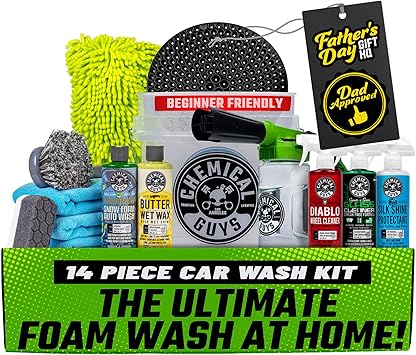
Chemical Guys HOL126 14-Piece Car Wash Kit
The most popular starter kit for a reason — it covers wash, foam, wheels, interior, and drying in one box. Includes Chemical Guys' flagship Honey Dew Snow Foam, Wheel Cleaner, Total Interior Cleaner, a Hydro Suds ceramic wash soap, and a waffle-weave drying towel. The bucket and foam cannon attachment make the two-bucket method immediately doable without hunting for extra supplies. Best for first-timers who want to do it right without assembling parts separately.
Pros
- Everything you need in one purchase
- Chemical Guys formulas are proven and widely trusted
- Includes a foam cannon attachment for pressure washer use
Cons
- Some buyers outgrow the included towels quickly
- Doesn't include clay bar — buy separately if needed
 Check Price on Amazon
Meguiar's Complete Car Care Kit
Meguiar's kits are the consistent choice for daily driver owners who want good results without enthusiast-level complexity. The formula lineup — Gold Class Car Wash, Ultimate Liquid Wax, Quik Detailer, and Endurance Tire Gel — handles exterior wash, protection, quick-detailing, and tire dressing. The wax is easy to apply and remove by hand. If you just want your car clean and protected with minimum fuss, this kit delivers reliably and costs less than Chemical Guys for comparable coverage.
Pros
- Trusted formulas with decades of proven results
- Easier to use than enthusiast-grade products
- Great value per wash compared to premium brands
Cons
- Gold Class Wax doesn't last as long as a sealant
- No foam cannon or wash bucket included
Adam's Polishes Total Interior Detailing Kit
The strongest interior-focused option on this list. Adam's formulates specifically for each interior surface type — their leather cleaner, interior detailer, and carpet/upholstery cleaner are each purpose-built rather than one all-purpose solution stretched across everything. The included brushes have the right bristle stiffness for vents, seams, and door cards without scratching. Best for buyers whose interior is the main focus and who already have exterior wash covered.
Pros
- Purpose-built formulas for each interior surface
- Excellent microfiber towels included
- Safe on all interior materials including leather and Alcantara
Cons
- No exterior products — exterior wash is separate
- Costs more per piece than big-box alternatives
Mothers CMX Ceramic + Carnauba Combo Kit
A smart hybrid kit that pairs Mothers' CMX Ceramic Spray Coat with their California Gold carnauba wax. The ceramic spray goes on first as a durable base layer (6–12 months of protection). The carnauba tops it for added gloss depth. It's an unusually complete protection stack for a single kit purchase. Best for owners who care about paint protection longevity and want a showroom-quality result that holds up for months rather than weeks.
Pros
- Ceramic + carnauba layering for maximum protection and gloss
- Ceramic component lasts significantly longer than wax alone
- Both products are straightforward to apply by hand
Cons
- Two-step process takes more time
- No wash or drying products included
Griot's Garage Complete Car Care Kit
Griot's occupies a sweet spot between mass-market and enthusiast pricing. Their car wash soap is genuinely excellent — low-sudsing, pH-balanced, and safe for ceramic-coated paint. The spray-on wax is the fastest paint protection in the category: apply on a wet or dry panel, spread, and rinse or wipe off. No haze stage, no buffing. Best for owners who want Griot's quality without the Chemical Guys or Adam's premium markup.
Pros
- Spray wax is extremely fast to apply — great for time-pressed owners
- Safe on ceramic coatings, waxed paint, and bare paint
- Consistent product quality across the Griot's lineup
Cons
- Spray wax protection doesn't last as long as a proper sealant
- Smaller product volume than some competitors at similar price
⚠️ Common Home Detailing Mistakes
Washing in circular motions: Circular scrubbing is how swirl marks happen. Always use straight back-and-forth or overlapping straight-line passes with your mitt.
Using household cleaners on car paint: Glass cleaner with ammonia, all-purpose spray, and dish soap all strip wax and sealant protection and can dull clear coat over time. Use only pH-balanced car wash soap on painted surfaces.
Detailing in direct sunlight: Heat causes soap and wax to dry before you can work them properly. Residue bakes into the paint and is difficult to remove. Always detail in the shade or indoors.
Using the same towels for paint and interior: Cross-contaminating towels transfers brake dust, silicone, and tire dressing to painted surfaces. Color-code your microfibers — one color for paint, one for glass, one for interior.
Skipping the second bucket: One bucket is the single biggest cause of swirl marks. The second rinse bucket with a grit guard at the bottom captures the contaminants from your mitt before it goes back in the soap. Non-negotiable.